Use this in Arrangement Calculator
Create your account and jump straight into Arrangement Calculator when you are ready to apply this article.
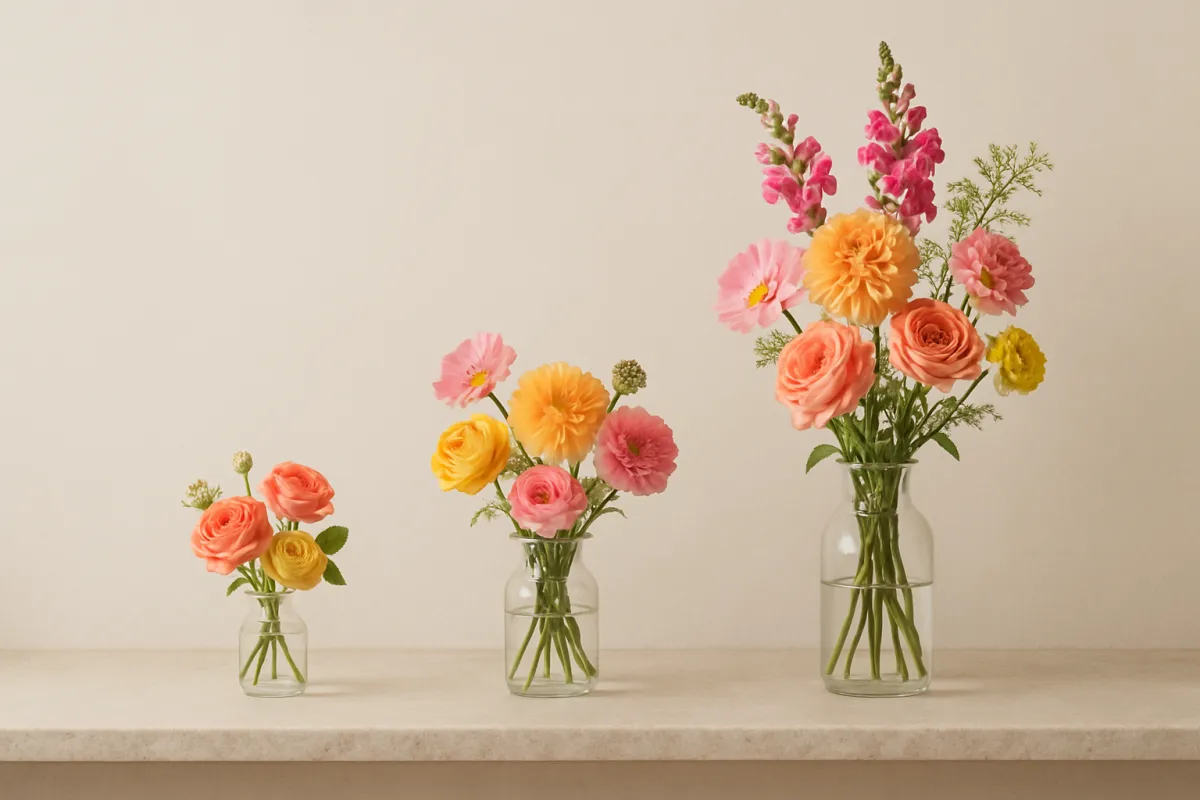
The 3:5:8 rule in floristry is a way to compare proportions within a design. It does not require every bouquet to contain three focal, five secondary and eight filler stems. You can try those quantities as an exercise, but choose the finished recipe for the flowers, container and brief.
Where Does The 3:5:8 Ratio Come From?
3, 5 and 8 are consecutive Fibonacci numbers. The ratios 5 ÷ 3 and 8 ÷ 5 are approximately 1.67 and 1.6. Ratios of later consecutive terms approach the golden ratio, about 1.618.
The Texas State Florists’ Association design course, pages 13–14, uses 3:5:8 to discuss comparative proportions. It applies the idea to dimensions, shapes, open space and the amounts of colour or texture. That is broader than counting stems, and it is a design convention rather than a guarantee that everyone will prefer the result.
Using The Ratio To Count Your Flowers
For a practice bouquet, try this chosen recipe:
- 3 focal stems: the flowers you want to draw attention to.
- 5 secondary stems: supporting flowers.
- 8 filler or foliage stems: material that finishes this particular design.
Check the result before adopting it as a shop recipe. Three large flower heads occupy a different amount of space from three small ones. A stem count alone cannot describe the finished shape.
Height And Width Proportions
The association's course gives a traditional starting point of material at about 1.5 times a tall container's height, or a low container's width. It also notes that the container's visual weight affects the decision. This does not mean every vase needs flowers exactly 1.5 times its opening width.
Check the intended position, viewing height and stability of the arrangement. For table flowers, confirm the brief and sightlines rather than choosing a height from the ratio alone.
Worked Example: A £65 Hand-Tied Bouquet
These are illustrative purchase costs and pricing allowances, excluding reclaimable VAT. They are not supplier quotes or a recommended markup.
- 3 focal stems at £1.15: £3.45.
- 5 secondary stems at £1.00: £5.00.
- 8 filler stems at £0.85: £6.80.
The stem cost is £15.25. An example 2.5x markup gives £38.13 after rounding. Add £10 labour and £5 sundries for £53.13 before output VAT. At 20% VAT, those rounded figures give £10.63 VAT and £63.76 including VAT. The example £65 selling price rounds that up; check your own costs before choosing a price.
The Arrangement Calculator prices the quantities you enter using your costs, markups and labour. It does not choose design proportions or impose a 3:5:8 recipe.
Using A Recipe For Staff Training
Once you have made and checked a design, record its actual stems, quantities, container and make-up instructions. Use the Arrangement Calculator to cost that recipe. Store the product's ingredient list and price in Digital Florists so the team can refer to the same information.
Recheck the recipe when you substitute flowers. Matching a stem count does not guarantee the same appearance or cost.
Practise It Deliberately
Make a practice bouquet with the 3, 5 and 8 groups. Photograph it, then change one group and compare the shape, coverage and cost. Keep the version that meets your brief; there is no need to force the ratio when it does not help.
Run different recipes through the Arrangement Calculator to compare their costs separately from your design judgement.
Common Questions
What is the 3:5:8 rule in floristry?
It is a proportion guideline. The numbers can describe relative dimensions or amounts within a design, rather than a compulsory recipe of focal, secondary and filler stems.
How does it relate to Fibonacci and the golden ratio?
3, 5 and 8 are consecutive Fibonacci numbers. Their ratios approximate the golden ratio; later consecutive terms approach it more closely.
Do the numbers have to be exactly 3, 5 and 8?
No. A ratio can be scaled: 6:10:16 has the same proportions. The quantities you use still need to suit the flowers and design.
Does it work for funeral and sympathy flowers?
You can consider proportions, but a tribute's required shape, coverage and mechanics determine its recipe. Do not use the ratio as a substitute for checking those requirements.
How tall should flowers be above a container?
Use the container, position and brief to decide. The traditional 1.5x guideline is a starting point for considering proportion, not a fixed height for every design.
Ready to apply this?
Open the florist tools that save the most time first
Start with Arrangement Calculator and move from reading to doing in one step.
Try next
More tools for this topic
Arrangement Calculator
Price individual arrangements from stem and sundry costs. Choose pre-tax markups, add labour and tax once, the...
Pricing Guide Generator
Create printable pricing guides for your team with flower markups, labour costs and sundries at every price po...
Business Markup Calculator
Turn your annual overheads, stock spend and profit goal into the one average markup your shop needs. Or start...