Use this in Arrangement Calculator
Create your account and jump straight into Arrangement Calculator when you are ready to apply this article.
The 3:5:8 rule is one of the most useful design principles in floristry. It gives you a reliable framework for building arrangements that look balanced, feel intentional, and can be replicated by every member of your team.
Where Does the 3:5:8 Ratio Come From?
The numbers 3, 5 and 8 are consecutive terms in the Fibonacci sequence — a pattern found throughout the natural world, from the spiral of a sunflower head to the branching of fern fronds. As the sequence progresses, the ratio between consecutive terms converges on approximately 1:1.618, known as the golden ratio.
Using Ratio to guide you in Floristry - Number of flowers
- 3 — the number of focal flowers (your stars, the most expensive and eye-catching stems)
- 5 — the number of secondary flowers (supporting blooms that complement the focals)
- 8 — the number of filler stems (foliage, texture flowers, or smaller blooms that complete the arrangement)
Height and Width Proportions
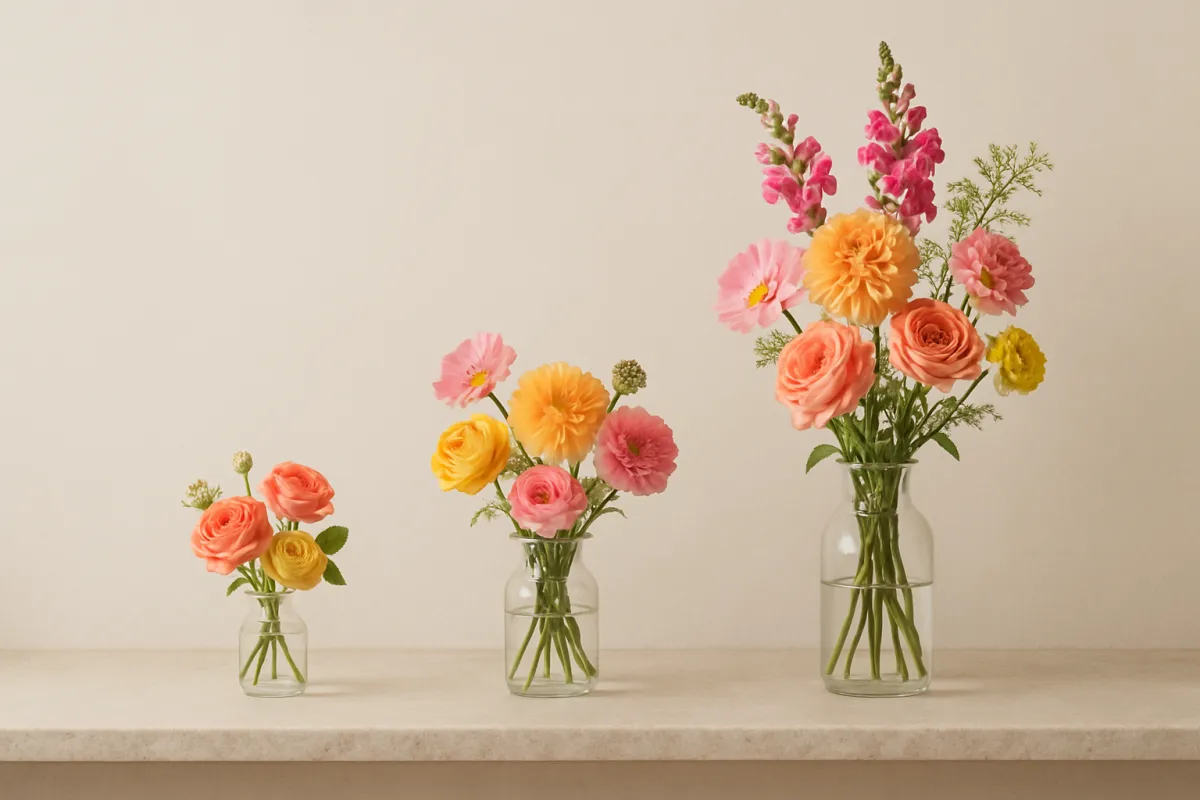
A classic guideline is that the visible arrangement above the container should be roughly 1.5 times the height of the container itself. For a vase that stands 20cm tall, your flowers should extend approximately 30cm above the rim.
The same thinking applies to width. An arrangement that is roughly 1.5 times the width of the container opening tends to look well-proportioned.
Worked Example: A £65 Hand-Tied Bouquet
- 3 focal stems — large-headed roses such as Mondial or Naomi varieties. At roughly £1.15 per stem wholesale, that is £3.45.
- 5 secondary stems — spray roses or ranunculus. At around £1 per stem, that is £5.00.
- 8 filler stems — a mix of eucalyptus, pittosporum and waxflower. At approximately £0.85 per stem, that is £6.8
Your total stem cost comes to £15.25, Mark that up to your retail ex Vat - x 2.5 = £38.13 add Labour £10 Sundries box, wrap card etc £5 = £53.13 add VAT = £63.75
If you want to take the guesswork out of these pricing calculations, the Arrangement Calculator will work out your stem counts and proportions for any given budget and container size.
Why It Matters for Pricing and Staff Training
The 3:5:8 rule solves consistency by giving your team a simple, memorable formula. New staff can follow the ratio from day one, and experienced florists can use it as a starting point.
From a pricing perspective, standardised stem counts mean standardised costings. The Arrangement Calculator is built around precisely this principle.
Common Mistakes to Avoid
Over-thinking it. The 3:5:8 rule is a guideline, not a rigid law.
Ignoring it for funeral work. Tributes and spray work still benefit from the same proportional thinking.
Forgetting the container. The proportions include the container. A tall, slender vase needs different stem heights than a low, wide bowl.
Using it as an excuse to under-fill. The ratio scales cleanly — 6:10:16 follows the same logic and gives you 32 stems.
Practise It Deliberately
Next time you are making up a bouquet, consciously count your stems into groups of 3, 5 and 8. Photograph the result. Then make another without thinking about the ratio and compare the two.
The result is often that the arrangment that has followed the ratio rule often look more visually pleasing to the eye.
If you would like to experiment with different stem combinations, try running a few scenarios through the Arrangement Calculator.
Ready to apply this?
Open the florist tools that save the most time first
Start with Arrangement Calculator and move from reading to doing in one step.
Try next
More tools for this topic
Arrangement Calculator
Price individual arrangements with live stem and sundry costs, markups, labour, and VAT so every quote protect...
Business Markup Calculator
Set default markups for flowers, sundries and labour — model promotions, discounts and seasonal offers to see...
Tribute Calculator
Price tribute letters, words, and shapes with accurate stem counts, OASIS frame costs, and variety comparison...