Use this in Arrangement Calculator
Create your account and jump straight into Arrangement Calculator when you are ready to apply this article.
Your phone camera is good enough. The iPhone 13 onwards and any flagship Android from the last three years can produce images that look excellent on Instagram, your website, and in print. The difference between a mediocre flower photo and a stunning one is almost never the equipment. It is lighting, composition, and a few minutes of editing.
This guide is specifically for florists who want to improve their photography without buying a camera, hiring a photographer, or spending hours on post-production.
Lighting
Lighting is the single most important factor in flower photography. Get this right and everything else follows.
Natural Light Is Free and Superior
Position your arrangement near the largest window in your shop or studio. The ideal setup is indirect natural light from one side. Direct sunlight creates harsh shadows and washes out delicate petal colours, so if the sun is streaming in, diffuse it with a sheer curtain, a sheet of greaseproof paper taped to the glass, or simply wait for a cloud.
Overcast days are your best friend. Cloud cover acts as a giant softbox, producing even, diffused light that flatters every flower. If you can only photograph on sunny days, shoot in the shade or use a north-facing window.
The Reflector Trick
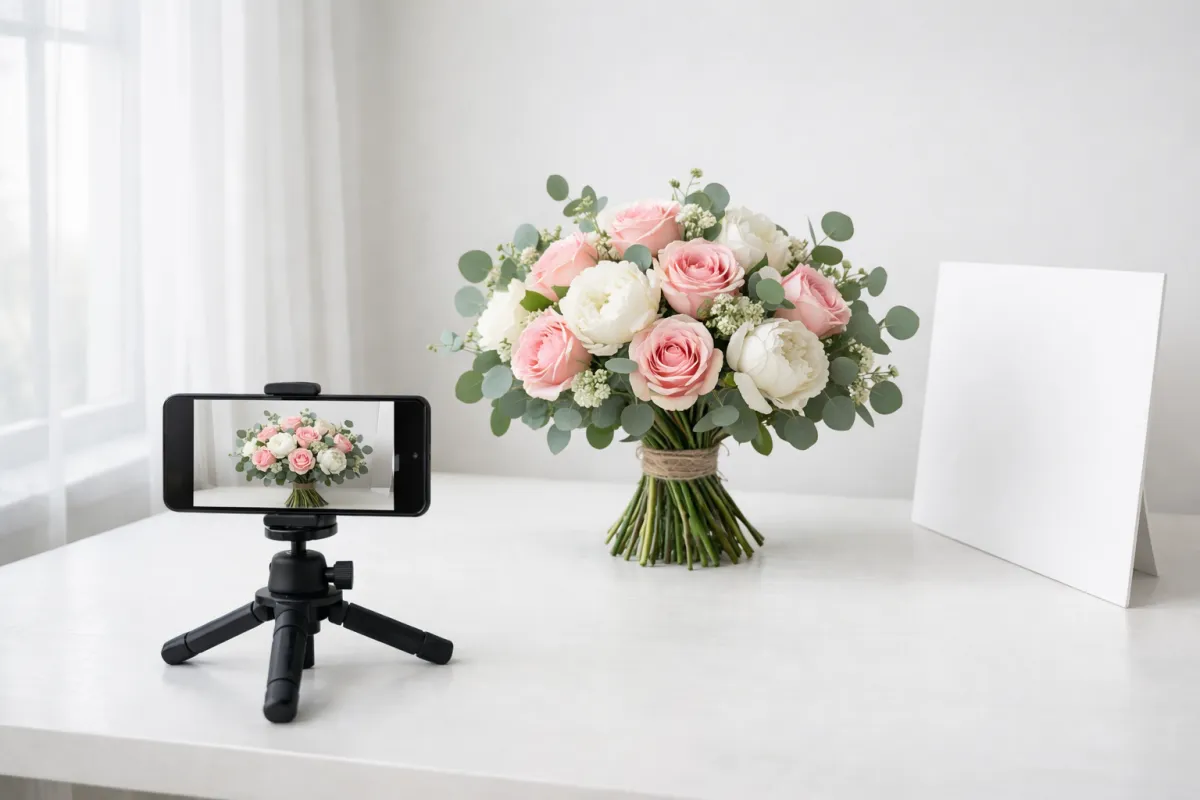
Place a piece of white A2 card or white foam board opposite your light source. This bounces light back into the shadows on the dark side of your arrangement, reducing contrast and revealing detail in every petal.
A piece of tin foil wrapped around cardboard works too, though it gives a slightly harder, more directional fill. White card gives the softest, most natural result.
Cost: free to £2 from a craft shop.
Avoid Shop Lighting for Photos
Overhead fluorescent tubes add a green colour cast. Warm tungsten bulbs turn everything orange. Mixed lighting (daylight from a window plus shop lights overhead) confuses your phone's white balance and produces muddy colours.
When photographing, turn off the overhead lights and rely on window light alone. If your shop has no good natural light, a 10-inch ring light set to daylight (5500K) positioned to one side is a worthwhile investment at around £20-30.
Backgrounds and Staging
What Works
Solid colours let the flowers speak. White is clean and professional. Grey or charcoal is sophisticated. Black creates drama with light-coloured blooms. Muted sage, dusty pink, or cream give a lifestyle feel without competing with the arrangement.
Textured surfaces add warmth. Weathered wood suits garden-style arrangements. Marble or stone signals luxury. Linen fabric works beautifully for flat lays.
DIY options on a budget:
- Large sheets of coloured card from craft shops (A1 size, £3-5 each)
- A sheet of MDF painted in matte finish (gloss creates reflections)
- A clean bedsheet draped over a table
What to Avoid
Busy patterned surfaces, shiny or reflective tables, bright coloured walls, and cluttered backgrounds. If your shop counter is messy, lay a clean surface on top before shooting.
Props
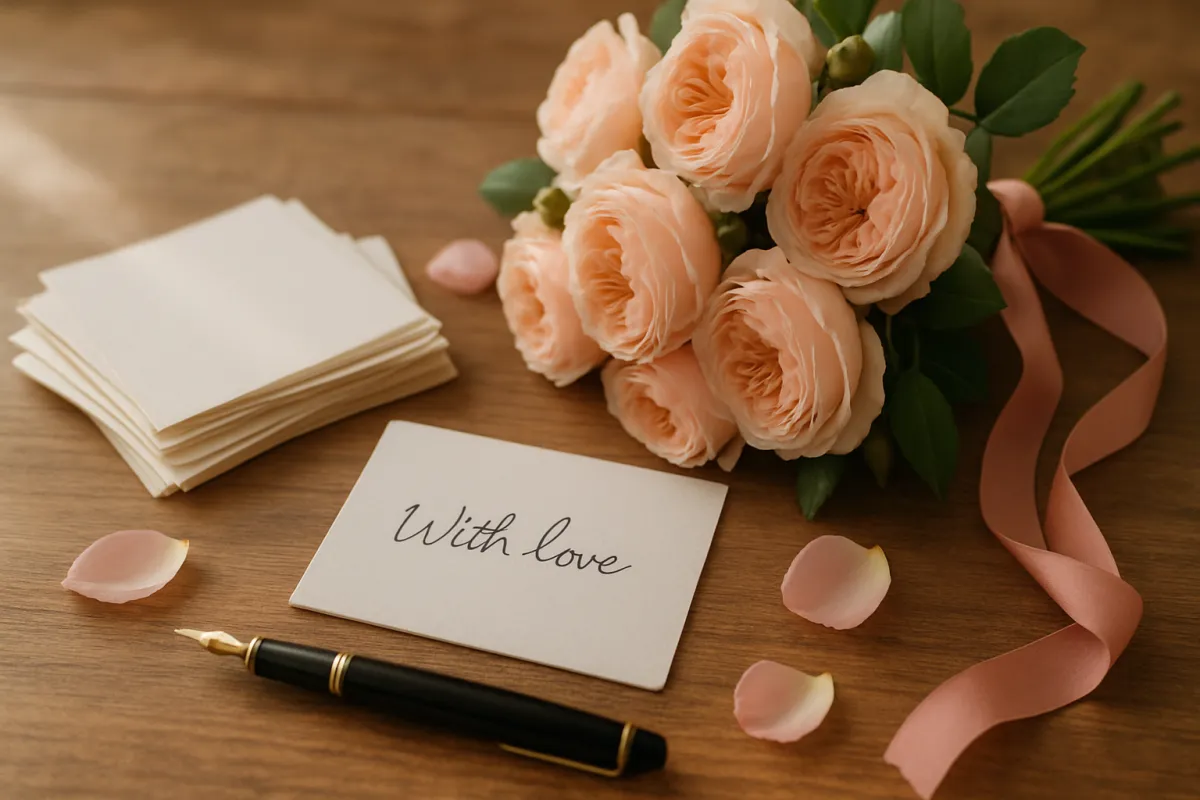
Keep them minimal. Ribbon, twine, a pair of decorative scissors, handwritten gift tags, or branded tissue paper can add context. Seasonal items (pine cones in winter, citrus slices in summer) work in moderation. Props should complement the flowers, never compete with them.
Composition
Rule of Thirds
Enable the grid overlay in your phone camera settings (on iPhone: Settings > Camera > Grid). Place the focal point of your arrangement at one of the four intersection points rather than dead centre. This creates a more dynamic, professional-looking image.
Breaking the rule works too. Centre composition is effective for a single, symmetrically perfect bloom viewed head-on, such as a dahlia or a sunflower.
Angles
45 degrees is the most versatile angle. It shows both the top and the profile of an arrangement, mimicking how a customer actually sees the flowers. This is your default.
Overhead (90 degrees) works for flat lays, wreaths, table centrepieces, and flower crowns. Use the grid overlay to keep the frame level.
Eye level creates drama for tall arrangements and single stems. Get down to the level of the flowers rather than shooting downward.
Negative Space
Leave empty space around the arrangement. This draws the eye to the flowers, creates a professional feel, and gives you room to overlay text if needed (for Instagram announcements, pricing, or quotes).
Detail Shots
Always capture both a full arrangement shot and close-up details: a single bloom, the ribbon tie, a dewdrop on a petal, the layered texture of a garden rose. Use these as carousel slides on Instagram. The combination tells a complete story and increases time spent on your post.
Editing
You do not need to spend money on editing software. These three apps cover everything a florist needs.
Snapseed (Free)
The best free photo editor available. No ads, no in-app purchases, 29 tools.
Quick workflow:
- Open image, use the Rotate tool to straighten if needed
- Tune Image: tap auto-correct as a starting point, then adjust Brightness, Contrast, and Saturation manually
- Use the Healing tool to remove distracting elements (stray leaves, marks on the backdrop)
- Apply a subtle Vignette to draw focus to the centre
- Export
Lightroom Mobile (Free with Premium Option)
More powerful than Snapseed, with the killer feature of presets (saved editing recipes you can apply to every photo for a consistent look). The free version handles basic editing. The full version (part of Adobe Photography Plan at approximately £9.99/month) adds RAW editing, masking, and preset syncing.
The preset advantage: Edit one photo to perfection. Save it as a preset. Apply that preset to every subsequent photo for a consistent feed aesthetic. This is how the best florist Instagram accounts maintain their visual identity.
VSCO (Free Core, Premium Approximately £4/Month)
Specialist in film-emulation presets that give a warm, analog look to flower photos. The Kodak Portra and Fuji 160NS style presets are particularly flattering for pastel blooms. Best for creating a cohesive, editorial Instagram aesthetic.
Colour Accuracy
Flower colours are notoriously difficult to capture accurately.
Common Problems and Fixes
| Problem | Cause | Fix |
|---|---|---|
| Red roses look pink | Camera overexposes reds | Slightly underexpose (-0.3 to -0.7 EV), boost red saturation in editing |
| Purple flowers look blue | Digital sensor limitation | Increase the magenta Tint slider in editing |
| White flowers lose detail | Blown highlights | Underexpose slightly, reduce Highlights in editing |
| Everything looks orange | Warm indoor lighting | Turn off shop lights, shoot in daylight only |
| Colours look muted | Flat overcast light | Gentle boost to Vibrance (+10-20), not Saturation |
White Balance
If you want precise colour accuracy, buy a grey card (£5-10 from Amazon). Hold it in front of the flowers under your shooting light, photograph it, then use the white balance eyedropper in Lightroom on the grey card to set accurate white balance. Apply this setting to all photos shot under the same lighting.
For most day-to-day posting, shooting in natural daylight with your phone's auto white balance will be accurate enough.
Instagram Tips
Image Dimensions
| Format | Size | Ratio | When to Use |
|---|---|---|---|
| Feed post (portrait) | 1080 x 1350px | 4:5 | Single arrangement hero shots |
| Feed post (new grid) | 1080 x 1440px | 3:4 | Fills the new Instagram grid perfectly |
| Carousel | 1080 x 1350px | 4:5 | Same ratio for all slides, up to 20 images |
| Reels | 1080 x 1920px | 9:16 | Full vertical screen video |
| Stories | 1080 x 1920px | 9:16 | Behind-the-scenes, polls, quick updates |
Shoot portrait orientation (phone held vertically) for maximum visual impact on the feed.
Content That Performs Well
Time-lapse arrangement videos (Reels): Set your phone on a tripod, press record, and work naturally. Speed up to 15-30 seconds. Consistently one of the highest-performing content types for florists.
Before and after carousels: Slide 1 shows raw materials on the table. Slides 2-3 show work in progress. Slide 4 shows the finished arrangement. Transformation content is universally engaging.
Arrangement breakdowns: Name every flower and foliage in an arrangement with text labels or individual slides. Educational content gets saved and shared at high rates.
Behind the scenes: Early morning market runs, the workroom after a wedding prep day, packing orders. This humanises your brand and builds customer connection.
Posting Frequency
Aim for 3-5 feed posts per week, 2-3 Reels per week, and daily Stories. Consistency matters more than volume. Three quality posts per week delivered reliably will outperform seven mediocre ones.
Hashtags
Use 5-11 relevant hashtags per post. Mix sizes for best reach:
- Large (for discovery): #flowers, #flowerstagram, #bouquet
- Medium (more targeted): #ukflorist, #flowerphotography, #seasonalflowers
- Small/niche (highest engagement): #[yourcity]florist, #independentflorist, #britishflowers
Create a branded hashtag unique to your business and encourage customers to use it.
Equipment on a Budget
You can set up a complete flower photography station for under £100:
| Item | Cost | Purpose |
|---|---|---|
| Phone tripod | £15-30 | Steady shots, overhead flat lays, Reels |
| Ring light (10") | £20-30 | Even, shadow-free light when windows are not available |
| White card reflector | £0-2 | Bounces light into shadows |
| Background boards | £5-30 | Clean, consistent backdrops |
| Clip-on macro lens | £8-15 | Extreme close-ups for detail shots |
You do not need an expensive DSLR camera. You do not need a professional studio. A clear table by a window, a phone, and a piece of white card will take you further than you expect.
UK Florist Accounts Worth Studying
If you want to see what excellent flower photography looks like in practice, study these accounts:
- Scarlet & Violet (@scarletandviolet): The quintessential English garden aesthetic. Unstructured, romantic, muted tones. A masterclass in cohesive colour palettes.
- Grace & Thorn (@graceandthorn): Bold, edgy, modern. Breaks the "pretty pastel" mould with unusual varieties and a punk-meets-flowers vibe.
- McQueens Flowers (@mcqueensflowers): Polished, editorial-quality photography. Every post could be a magazine spread.
- WORM (@wormlondon): Natural, botanical, warm. Excellent mix of arrangement shots and educational content.
- Rona Wheeldon (@flowerona): A specialist flower photographer whose feed is a masterclass in technique.
Study what they do with lighting, backgrounds, and colour consistency. You will notice the same principles in this guide applied at a high level: natural light, clean backgrounds, consistent editing, and a thoughtful mix of content types.
Once you have great photos, you need great product names to go with them. Our Bouquet Name Generator creates creative names for your arrangements, and the Flower Bouquet & Arrangement Name Ideas page has hundreds of ready-made options to browse.
Ready to apply this?
Open the florist tools that save the most time first
Start with Arrangement Calculator and move from reading to doing in one step.
Try next
More tools for this topic
Arrangement Calculator
Price individual arrangements with live stem and sundry costs, markups, labour, and VAT so every quote protect...
Business Markup Calculator
Set default markups for flowers, sundries and labour — model promotions, discounts and seasonal offers to see...
Tribute Calculator
Price tribute letters, words, and shapes with accurate stem counts, OASIS frame costs, and variety comparison...