Use this in Arrangement Calculator
Create your account and jump straight into Arrangement Calculator when you are ready to apply this article.
VAT Registration for Irish Florists
In Ireland, you must register for VAT when your turnover exceeds certain thresholds. Since 1 January 2025, the thresholds are EUR 85,000 for the supply of goods and EUR 42,500 for the supply of services. Most florists primarily sell physical products (bouquets, arrangements, plants), so the higher goods threshold of EUR 85,000 typically applies. However, if you also offer services such as venue decoration or event styling charged separately, those revenues fall under the lower services threshold.
You must notify Revenue within 30 days of exceeding the threshold. Failure to do so can result in backdated registration and penalties.
Important: This is general guidance, not professional tax advice. Always consult a qualified accountant or tax adviser for advice specific to your circumstances.
Ireland's Two-Tier VAT Rate System for Florists
Understanding which rate applies to which product is critical because florists routinely sell items that fall under different VAT rates.
13.5% Reduced Rate
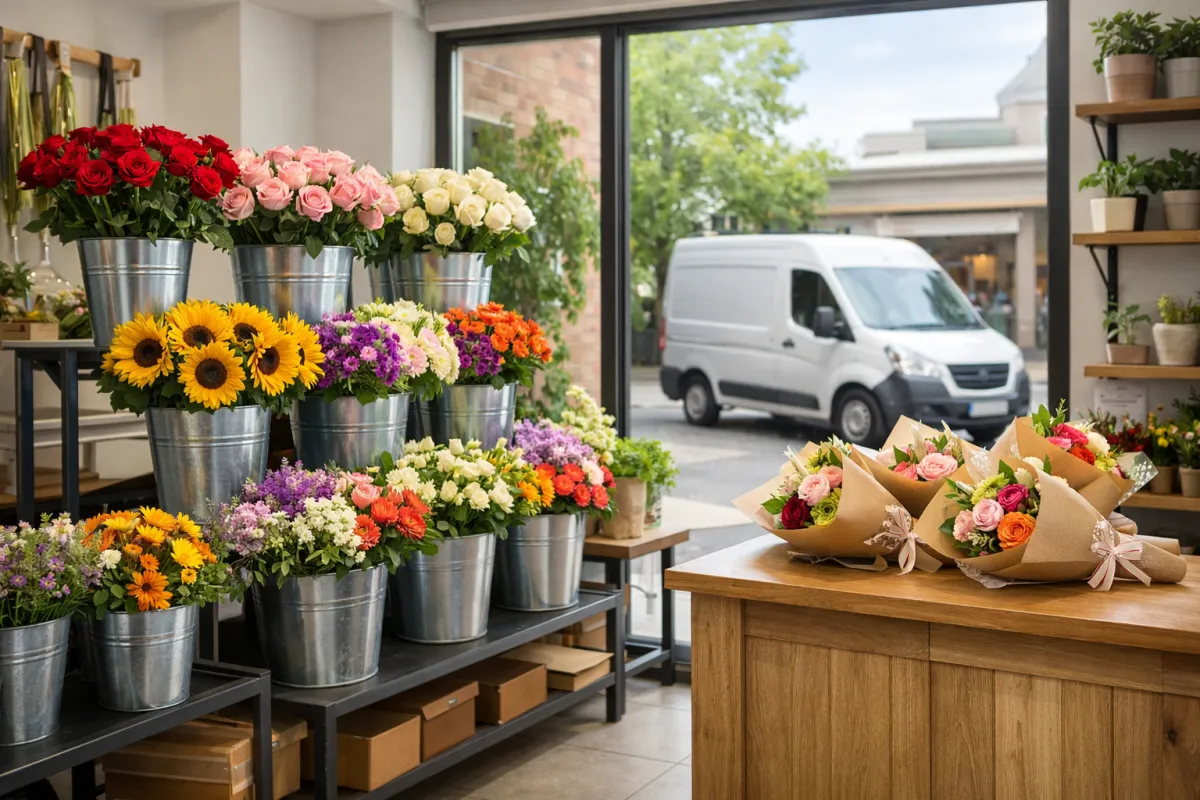
Fresh cut flowers, bouquets, floral arrangements made with fresh flowers, ornamental plants, flowering houseplants, and bulbs are all charged at the reduced rate of 13.5%. This is a genuine competitive advantage compared to the UK, where flowers are standard-rated at 20%.
The reduced rate applies to the flowers and the labour of arranging them when sold as a single supply. Wrapping materials, ribbon, and flower food included as part of a bouquet sale are also covered at 13.5%.
23% Standard Rate
Artificial flowers, preserved and dried arrangements, vases sold separately, gift items, candles, chocolates, soft toys, and standalone delivery charges are all subject to the standard rate of 23%.
Why the Distinction Matters — A Worked Example
A EUR 65 bouquet of fresh flowers at 13.5%: Net EUR 57.27, VAT EUR 7.73. A EUR 65 gift hamper at 23%: Net EUR 52.85, VAT EUR 12.15.
On the same selling price, the hamper generates EUR 4.42 more VAT liability. If you sell mixed products (flowers plus a candle plus chocolates), you should ideally separate the items on your invoice to apply the correct rate to each. Many point-of-sale systems allow you to assign different VAT rates to product categories.
Filing VAT Returns Through ROS
Irish VAT returns are filed bi-monthly using the VAT3 return through Revenue Online Service (ROS). There are six filing periods per year:
- January–February (due 23 March)
- March–April (due 23 May)
- May–June (due 23 July)
- July–August (due 23 September)
- September–October (due 23 November)
- November–December (due 23 January)
The deadline is the 23rd of the month following the end of the period when filing electronically through ROS. Paper returns have an earlier deadline on the 19th, but there is little reason not to file electronically.
On the VAT3, you report your total output VAT (VAT charged on sales), your total input VAT (VAT paid on business purchases), and pay the difference to Revenue. If your input VAT exceeds your output VAT — common when investing in equipment or during a slow period — you can claim a refund.
Cash Receipts Basis
The cash receipts basis is available if your annual turnover is under EUR 2 million or if 90% or more of your sales are to non-VAT-registered customers. Under this method, you account for VAT when you actually receive payment rather than when you issue the invoice. This is particularly helpful for wedding and corporate work where payment often comes weeks or months after the initial booking.
To use the cash receipts basis, you must apply to Revenue in writing. Once approved, it applies to all your sales — you cannot pick and choose which transactions to apply it to.
Should You Register Voluntarily?
If your turnover is below EUR 85,000, voluntary registration might make sense if you are investing heavily in equipment or fit-out, you buy large volumes from VAT-registered wholesalers, or you supply other VAT-registered businesses who can reclaim VAT.
Voluntary registration is less worthwhile if the vast majority of your customers are private individuals, since adding 13.5% to your prices may make you less competitive against non-registered florists.
Common VAT Mistakes Irish Florists Make
- Applying the wrong rate — fresh flowers are 13.5%, dried flowers and artificial arrangements are 23%
- Not separating delivery VAT — standalone delivery charges carry 23%, not 13.5%
- Late filing — Revenue applies a surcharge of up to 10% of the VAT due for late returns
- Not monitoring the rolling 12-month threshold — track your turnover monthly
- Forgetting to reclaim input VAT — van fuel, phone bills, software subscriptions, wholesale flower purchases, and even flowers you discard are all reclaimable
- Mixing personal and business expenses — keep separate bank accounts to simplify returns and avoid Revenue queries
Setting Money Aside for VAT
Because the reduced rate of 13.5% applies to most of your sales, your effective VAT burden is lower than many retail businesses. Set aside approximately 8-10% of total takings into a separate bank account each week so your bi-monthly bill never comes as a shock. The Tax Reserve Calculator helps work out the right amount based on your actual sales mix. Combine it with the Operating Cost Calculator to build VAT obligations into your overall financial planning.
Get Professional Help
Find an accountant familiar with the retail or hospitality sector in Ireland. A good tax adviser will save you far more than their fees by ensuring you apply the correct rates, claim every input credit, and file on time.
Ready to apply this?
Take this pricing advice straight into your next quote
Start with Arrangement Calculator and move from reading to doing in one step.
Try next
More tools for this topic
Arrangement Calculator
Price individual arrangements with live stem and sundry costs, markups, labour, and VAT so every quote protect...
Bouquet Name Generator
AI-crafted bouquet names tuned for weddings, sympathy, seasonal campaigns, and everyday ranges — ready to past...
Tribute Calculator
Price tribute letters, words, and shapes with accurate stem counts, OASIS frame costs, and variety comparison...